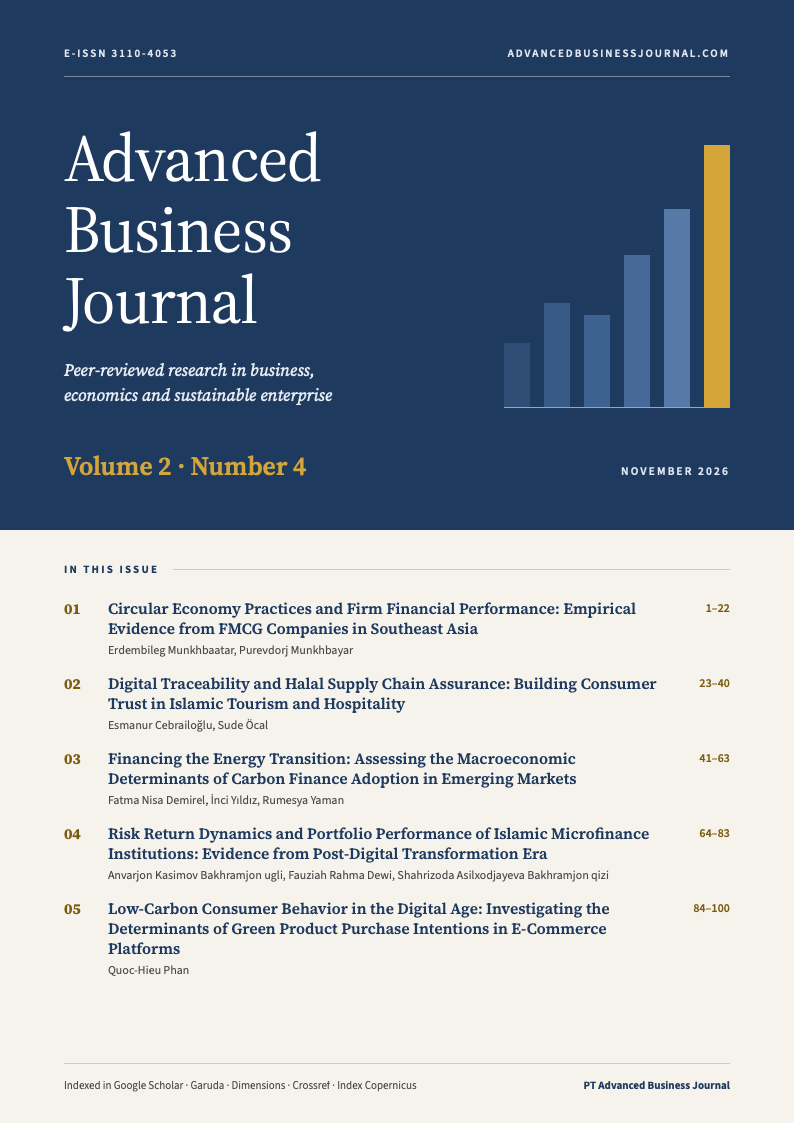
Digital Traceability and Halal Supply Chain Assurance: Building Consumer Trust in Islamic Tourism and Hospitality
DOI:
https://doi.org/10.65875/khxb7x95Keywords:
Halal tourism, Digital traceability, Supply chain assurance, Consumer trust, Blockchain, Islamic hospitality, Halal certification, Strategic marketingAbstract
Halal tourism and hospitality depend on more than the availability of Muslim-friendly facilities: consumers must be able to trust that food, ingredients, handling practices, accommodation services, and related experiences conform to the standards they expect. Digital traceability technologies—including blockchain-enabled records, QR-linked product information, Internet of Things (IoT) sensors, digital certification registries, and interoperable data platforms—can make supply-chain evidence more accessible and strengthen assurance across fragmented service networks. Yet technology does not automatically produce trustworthy halal outcomes. Inaccurate source data, weak governance, inconsistent certification, privacy concerns, and poor consumer-facing communication can undermine the credibility of digital systems. The analysis proposes that traceability affects trust primarily through perceived transparency and assurance credibility, with certification governance and platform interoperability shaping the strength of these relationships. The article also identifies risks associated with “technology-washing,” fragmented standards, and the mistaken assumption that immutable records guarantee truthful inputs. It concludes with a set of testable hypotheses, an empirical research design, and strategic implications for destination managers, hospitality firms, halal certifiers, technology providers, and Islamic finance stakeholders.
References
Abror, A., Patrisia, D., Trinanda, O., Omar, M. W., & Wardi, Y. (2021). Antecedents of word of mouth in Muslim-friendly tourism. Journal of Islamic Marketing. https://www.emerald.com/insight/publication/issn/1759-0833
Adoption of blockchain technology to improve Halal supply chain performance and competitiveness. (2022). Journal of Islamic Marketing, 14(9), 2343–2360. https://doi.org/10.1108/JIMA-02-2022-0050
Alamsyah, A., Hakim, N., & Hendayani, R. (2022). Blockchain-Based Traceability System to Support the Indonesian Halal Supply Chain Ecosystem. Economies, 10(6), 134. https://doi.org/10.3390/economies10060134
Ali, M. H., Suleiman, N., Khalid, N., Tan, K. H., Tseng, M.-L., & Kumar, M. (2021). Supply chain resilience and halal food integrity: A review and research agenda. International Journal of Logistics Management. https://www.emerald.com/insight/publication/issn/0957-4093
Buhalis, D., Leung, D., & Lin, M. (2023). Metaverse as a disruptive technology revolutionising tourism management and marketing. Tourism Management, 97, 104724. https://doi.org/10.1016/j.tourman.2022.104724
Casino, F., Dasaklis, T. K., & Patsakis, C. (2021). A systematic literature review of blockchain-based applications: Current status, classification and open issues. Telematics and Informatics, 36, 55–81. https://doi.org/10.1016/j.tele.2018.11.006
CrescentRating. (2023). Muslim-friendly travel and destination development: Industry insights. https://www.crescentrating.com/
DinarStandard. (2023). State of the Global Islamic Economy Report 2023/24. https://www.dinarstandard.com/post/state-of-the-global-islamic-economy-report-2023
Dwivedi, Y. K., Ismagilova, E., Hughes, D. L., et al. (2021). Setting the future of digital and social media marketing research: Perspectives and research propositions. International Journal of Information Management, 59, 102168. https://doi.org/10.1016/j.ijinfomgt.2020.102168
Effect of destination competitiveness attributes on tourists’ intention to visit halal tourism destination in Indonesia. (2022). Journal of Islamic Marketing, 14(4), 937–965. https://doi.org/10.1108/JIMA-12-2020-0368
European Commission. (2022). Digitalisation of the food system and traceability initiatives. https://food.ec.europa.eu/
Fang, M. S. (2026). The impact of supply chain risk management on financial performance: Evidence from the Southeast Asian manufacturing sector. Advanced Business Journal, 2(1), 45–55. https://doi.org/10.65875/6f1b9z89
GS1. (2023). GS1 Global Traceability Standard. https://www.gs1.org/standards/traceability
Gursoy, D., Malodia, S., & Dhir, A. (2022). The metaverse in the hospitality and tourism industry: An overview of current trends and future research directions. Journal of Hospitality Marketing & Management. https://doi.org/10.1080/19368623.2022.2072504
Hasan, M., & Saiyed, S. (2026). Unlocking supply chain resilience: The impact of artificial intelligence and IoT integration in agribusiness operations. Advanced Business Journal, 2(3), [pages]. [DOI]
Hastig, G. M., & Sodhi, M. S. (2021). Blockchain for supply chain traceability: Business requirements and critical success factors. Production and Operations Management. https://doi.org/10.1111/poms.13147
Helo, P., & Shamsuzzoha, A. H. M. (2021). Real-time supply chain—A blockchain architecture for project deliveries. Robotics and Computer-Integrated Manufacturing. https://doi.org/10.1016/j.rcim.2020.101909
Hidayat, S., & Fang, M. S. (2026). Blockchain technology in supply chain auditing: Enhancing transparency and reducing information asymmetry in accounting systems. Advanced Business Journal, 2(3), [pages]. [DOI]
Hollebeek, L. D., Sprott, D. E., Andreassen, T. W., et al. (2021). Customer engagement in evolving technological environments: Synopsis and guiding propositions. European Journal of Marketing. https://www.emerald.com/insight/publication/issn/0309-0566
Islamic Development Bank Institute. (2022). Islamic finance and the halal economy: Policy and market perspectives. https://isdbinstitute.org/
ISO. (2021). ISO 22005: Traceability in the feed and food chain—General principles and basic requirements for system design and implementation. https://www.iso.org/standard/36297.html
ISO. (2022). ISO 22000: Food safety management systems—Requirements for any organization in the food chain. https://www.iso.org/standard/65464.html
Jannah, S. M., & Al-Banna, H. (2021). Halal Awareness and Halal Traceability: Muslim Consumers’ and Entrepreneurs’ Perspectives. Journal of Islamic Monetary Economics and Finance, 7(2). https://doi.org/10.21098/jimf.v7i2.1328
Kamble, S. S., Gunasekaran, A., & Sharma, R. (2021). Modeling the blockchain enabled traceability in agriculture supply chain. International Journal of Information Management. https://doi.org/10.1016/j.ijinfomgt.2019.05.023
Kouhizadeh, M., Saberi, S., & Sarkis, J. (2021). Blockchain technology and the sustainable supply chain: Theoretically exploring adoption barriers. International Journal of Production Economics, 231, 107831. https://doi.org/10.1016/j.ijpe.2020.107831
Kshetri, N. (2021). Blockchain and supply chain management: Theoretical implications and practical applications. International Journal of Information Management. https://www.sciencedirect.com/journal/international-journal-of-information-management
Kumar, A., Liu, R., & Shan, Z. (2021). Is blockchain a silver bullet for supply chain management? Technical challenges and research opportunities. Decision Sciences. https://onlinelibrary.wiley.com/journal/15405915
Mahsun, M., Putra, Y. H. S., Asnawi, N., Djalaluddin, A., & Hasib, N. (2023). Blockchain as a Reinforcement for Traceability of Indonesian Halal Food Information through the Value Chain Analysis Framework. Al-Muqayyad, 6(1), 49–66. https://doi.org/10.46963/jam.v6i1.1031
Mastercard-CrescentRating. (2024). Global Muslim Travel Index 2024. https://www.crescentrating.com/reports/global-muslim-travel-index-2024.html
Olya, H. G. T., Al-ansi, A., & Al-Ansi, A. (2021). Risk perception and tourist behavior in Muslim-friendly hospitality settings. Journal of Islamic Marketing. https://www.emerald.com/insight/publication/issn/1759-0833
Phattanaviroj, T., & Pattaradej, R. (2025). Green supply chain management and its impact on firm competitiveness in emerging markets. Advanced Business Journal, 1(1), 1–10. https://advancedbusinessjournal.com/index.php/abj/article/view/1
Queiroz, M. M., Telles, R., & Bonilla, S. H. (2021). Blockchain and supply chain management integration: A systematic review of the literature. Supply Chain Management: An International Journal. https://doi.org/10.1108/SCM-03-2018-0143
Rather, R. A. (2021). Monitoring the impacts of tourism-based social media, customer engagement and brand equity. Journal of Hospitality and Tourism Technology. https://doi.org/10.1108/JHTT-08-2020-0200
Rather, R. A., & Hollebeek, L. D. (2021). Customers’ service-related engagement, experience, and behavioral intent: Moderating role of age. Journal of Retailing and Consumer Services. https://www.sciencedirect.com/journal/journal-of-retailing-and-consumer-services
Rejeb, A., Rejeb, K., Simske, S. J., & Treiblmaier, H. (2021). Blockchain technologies in logistics and supply chain management: A bibliometric review. Logistics, 5(4), 72. https://doi.org/10.3390/logistics5040072
Saberi, S., Kouhizadeh, M., Sarkis, J., & Shen, L. (2021). Blockchain technology and its relationships to sustainable supply chain management. International Journal of Production Research. https://doi.org/10.1080/00207543.2018.1533261
Saurabh, S., & Dey, K. (2021). Blockchain technology adoption, architecture, and sustainable agri-food supply chains. Journal of Cleaner Production. https://www.sciencedirect.com/journal/journal-of-cleaner-production
Sidarto, L. P., & Hamka, A. (2021). Improving Halal Traceability Process in the Poultry Industry Utilizing Blockchain Technology: Use Case in Indonesia. Frontiers in Blockchain, 4, 612898. https://doi.org/10.3389/fbloc.2021.612898
Thomson Reuters & DinarStandard. (2023). Islamic Finance Development Report 2023. https://www.refinitiv.com/en/resources/special-report/islamic-finance-development-report
Treiblmaier, H. (2021). The impact of the blockchain on the supply chain: A theory-based research framework and a call for action. Supply Chain Management: An International Journal. https://doi.org/10.1108/SCM-01-2018-0029
Tönnissen, S., & Teuteberg, F. (2021). Analysing the impact of blockchain-technology for operations and supply chain management: An explanatory model drawn from multiple case studies. International Journal of Information Management. https://doi.org/10.1016/j.ijinfomgt.2019.05.017
UN Tourism. (2022). Tourism and digital transformation: Policy and practice perspectives. https://www.unwto.org/digital-transformation
UN Tourism. (2023). Tourism and the Sustainable Development Goals: Journey to 2030. https://www.unwto.org/tourism-in-2030-agenda
UNCTAD. (2021). Technology and innovation report 2021: Catching technological waves—Innovation with equity. https://unctad.org/publication/technology-and-innovation-report-2021
UNCTAD. (2024). Digital economy report 2024: Shaping an environmentally sustainable and inclusive digital future. https://unctad.org/publication/digital-economy-report-2024
UNEP. (2021). Food waste index report 2021. https://www.unep.org/resources/report/unep-food-waste-index-report-2021
UNEP. (2023). Turning off the tap: How the world can end plastic pollution and create a circular economy. https://www.unep.org/resources/turning-off-tap-end-plastic-pollution-create-circular-economy
Wang, Y., Han, J. H., & Beynon-Davies, P. (2021). Understanding blockchain technology for future supply chains: A systematic literature review and research agenda. Supply Chain Management: An International Journal. https://doi.org/10.1108/SCM-03-2018-0148
Wang, Z., Wang, T., Hu, H., Gong, H., Zhang, J., & Ren, X. (2021). Blockchain-based framework for improving supply chain traceability and information sharing. Journal of Cleaner Production. https://www.sciencedirect.com/journal/journal-of-cleaner-production
World Bank. (2022). Digital development overview: Data, digital platforms and inclusion. https://www.worldbank.org/en/topic/digitaldevelopment
World Economic Forum. (2022). Building trust in digital supply chains. https://www.weforum.org/
Downloads
Published
Issue
Section
License
Copyright (c) 2026 Esmanur Cebrailoğlu, Sude Öcal (Author)

This work is licensed under a Creative Commons Attribution 4.0 International License.